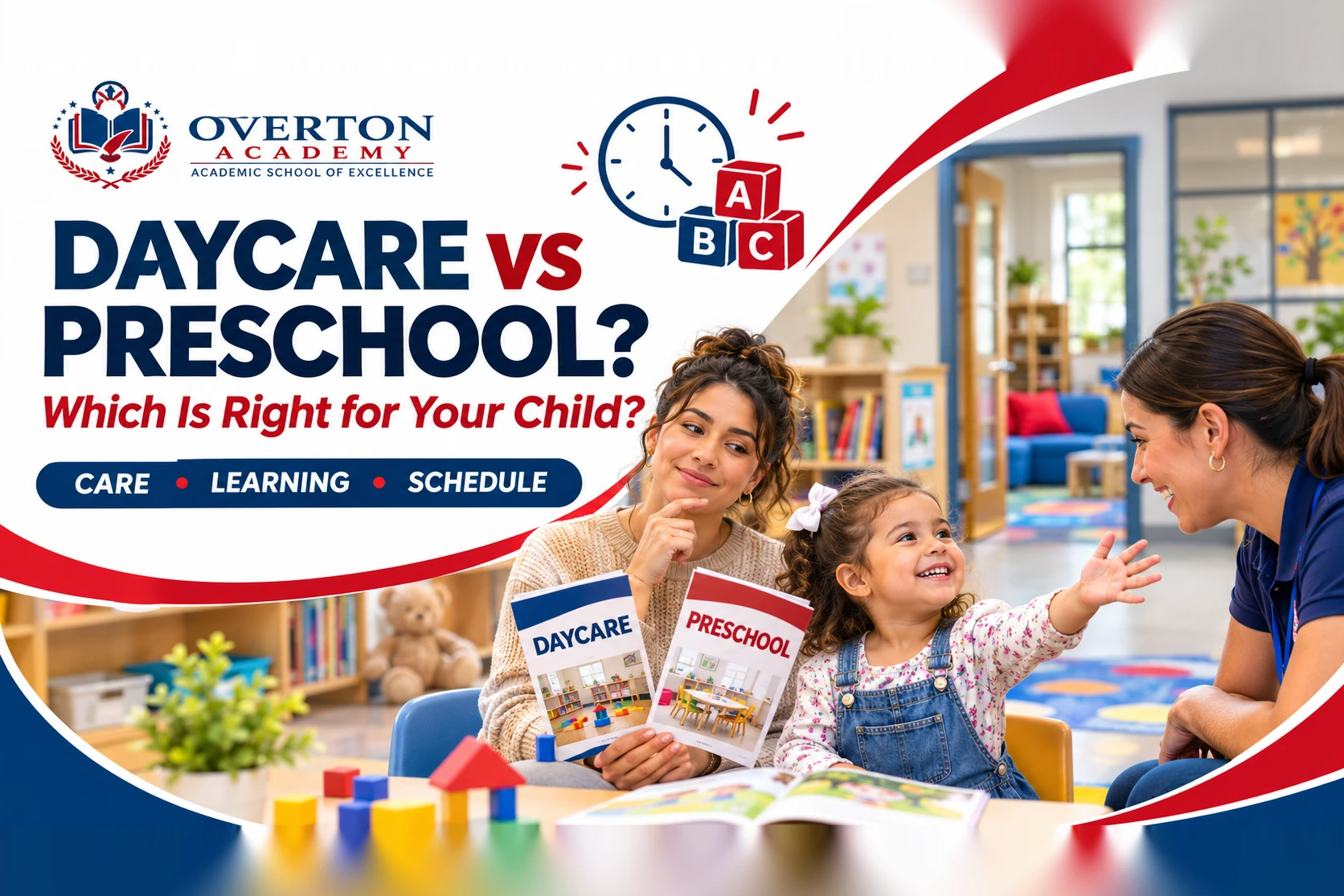
The tour guide hands you two brochures. One says daycare. The other says preschool. Both show smiling kids, bright classrooms, and a wall of tiny cubbies.
So which one fits your child? The daycare vs. preschool question stumps almost every parent, because the names sound distinct while the programs behind them often overlap.
Here is the short answer. Daycare is built around dependable care for the hours you need covered. Preschool is built around structured early learning that points toward kindergarten. The right pick depends on your child’s age, your schedule, and what a typical day looks like inside the classroom.
This guide covers the real differences, how costs compare, the signs a day is too long, and a four-part checklist you can carry on any tour. It also shows where Overton Academy fits, since the Uniondale, NY center offers both a daycare for ages 2 to 5 and a separate preschool program.
Key Takeaways
- Daycare centers on dependable care across a longer day, while preschool centers on structured learning that builds toward kindergarten. Both can include play, meals, and social time.
- Age matters, but readiness matters more. Preschool commonly serves ages 3 to 5, daycare often accepts younger children too, and cutoffs differ from program to program.
- The length of the day shapes how a child feels about any program. Match the schedule to your child, not just your calendar.
- Compare total weekly cost instead of tuition alone, and ask for a sample daily schedule before you decide.
What Is the Difference Between Daycare and Preschool?
Daycare focuses on dependable, all-day care for children while their parents work. Preschool focuses on structured early learning that prepares children for kindergarten. Daycare usually covers a wider age range and longer hours, while preschool typically serves ages 3 to 5 on a school-style schedule.
No single national definition covers both terms, and many centers blend them. Four differences still show up again and again.
Purpose
Daycare exists so your child is safe, fed, rested, and engaged while you work or study. Preschool exists to introduce early literacy, numbers, communication, and classroom routines.
Good daycare still teaches. Good preschool still cares for children. The difference is the program’s main job.
Schedule
Daycare programs often run long hours, and some stay open through summer and holiday breaks. Preschools commonly run a few hours a day or follow a school-year calendar, so working families sometimes need extra care before or after.
Daily rhythm
A daycare day is built around routines: meals, naps, outdoor play, and age-appropriate activities. A preschool day is organized around a curriculum or developmental framework, with group time, early reading, counting games, and small projects.
Age range
Daycare programs may accept infants and continue through the preschool years. Preschool usually starts around age 3, though some programs accept 2-year-olds and others serve only 4-year-olds.
Daycare vs preschool at a glance
| Daycare | Preschool | |
| Main goal | Dependable care plus age-appropriate learning | Structured early learning and kindergarten preparation |
| Typical ages | Infants through preschool age, depending on the center | Commonly 3 to 5, with cutoffs that vary |
| Typical hours | Often a full workday, sometimes year-round | Often part-day or on a school-year calendar |
| Daily rhythm | Meals, naps, play, and planned activities | Curriculum-based lessons plus play |
| Best for | Families who need full-day coverage | Children ready for group learning |
How Long Is Too Long for a Young Child’s Day?
For most families, the schedule decides a lot. The Center for American Progress reports that in 2023, 2.2 million parents of children under age 6 needed to change jobs, including quitting or turning down work, because of child care problems. Covering your hours is a real need, and daycare exists to meet it.
Still, a program that fits your calendar only works if the hours fit your child, too. Young children feel a long day differently than adults do, and naps, meals, and quiet time all have to fit inside it.
Watch for these signals:
- Your child asks to go home several times a day or resists drop-off more than before.
- Naps get short or get skipped.
- Evenings bring more meltdowns, or bedtime gets harder.
- Your child is too tired to eat well at the end of the day.
Eight hours with a beloved grandparent and eight hours in a busy classroom are different days. Neither is wrong, but each asks something different of your child.
If you see these signals, shorten the day, adjust drop-off, or ask the program how it handles rest. Many families also ease into a new setting with shorter days before moving to a full schedule.
How Do Daycare and Preschool Costs Compare?
Prices vary by location, child age, provider type, and hours. Child Care Aware of America put the national average annual price of child care at $13,184 in 2025, based on the 47 states with price data. Prices on Long Island may differ, so treat that number as context rather than a quote.
Full-time, year-round care generally costs more than a part-day program, especially for infants and younger toddlers who need more hands-on attention. But the sticker price can mislead. A part-day preschool may look cheaper and still cost more overall if you must pay for separate care to cover the rest of your workday.
Ask every program about:
- Registration and supply fees
- Meals and snacks
- Extended-hour charges
- Holiday and summer coverage
- Transportation, if offered
Financial help may exist too. Depending on where you live and your circumstances, parents may qualify for child care subsidies, tax benefits, or public preschool programs. Ask each program about tuition assistance, and check with local child care agencies.
Daycare vs Preschool: Use the 4S Check to Decide
Labels will not decide this for you. Four questions will.
The 4S Check
Schedule
Which hours must be covered, including commute time, early starts, and school holidays?
Stage
Where is your child developmentally? Age gives you a range, and readiness gives you the answer: joining group activities, following simple directions, and handling part of a classroom routine.
Structure
How much formal learning does your child enjoy, and how does the program plan its days? Ask to see a sample schedule.
Spending
What is the total weekly cost once you add before-care, after-care, meals, and fees?
The decision rule: If Schedule is your biggest constraint, start with daycare. If Structure and kindergarten preparation matter most and your hours are flexible, start with preschool. If both matter, look for a center that offers both.
What Do Most Parents Get Wrong When Choosing?
Five mistakes come up again and again.
- Do this: Ask for a sample daily schedule.
- Not that: Choose by the word on the sign.
- Do this: Ask how learning is planned in daycare.
- Not that: Assume daycare is only supervision, or that preschool is automatically better.
- Do this: Compare weekly totals, including gaps in coverage.
- Not that: Compare tuition numbers alone.
- Do this: Watch readiness cues like group play and following directions.
- Not that: Start preschool because a neighbor’s child did.
- Do this: Adjust the schedule when your child shows signs of tiredness.
- Not that: Push through and hope the routine settles on its own.
For a closer look at what structured early learning offers, read our guide to the benefits of preschool education.
What Does This Look Like in Real Life?
Here is a made-up example, not a real family, to show the thinking.
Picture a parent who works until 5:30 p.m. with a 30-minute commute. Their 3½-year-old loves stories, counts everything in sight, and naps for about an hour and a half after lunch.
A part-day preschool would suit the child’s curiosity, but it would leave the afternoon uncovered. A full-day daycare would cover the hours, but it only works if the day includes planned learning and a real nap window. The parent’s best question becomes: which program covers the whole day while still giving my child learning time that fits?
A center that offers both programs can solve this, because care and early learning can live under one roof.
Where Does Overton Academy Fit?
Overton Academy serves children ages 2 to 12 from two locations, Uniondale and West Hempstead, NY, and welcomes families from across Nassau County and Suffolk County. The center describes its teachers as certified and experienced.
For younger children, the daycare program for ages 2 to 5 offers dependable child care focused on learning, social development, and everyday growth.
When your child is ready for a more structured classroom, the preschool program brings together early literacy, foundational math, science discovery, art, music, and sensory play, and prepares children for a successful transition into pre-kindergarten.
Families who need longer coverage can also ask about before-school care and after-school care. Because availability and hours change, confirm current details with the team.
How Do You Choose in Five Steps?
- Map your hours. Write down the start and end times you need covered, plus holidays and summer weeks.
- Check the license. New York State’s guidance for families says choosing child care “sets the stage for healthy growth and development.” Use the state’s child care look-up to search regulated programs, and note that licensed programs must go through routine inspections.
- Ask for the sample day. Request a daily schedule and ask how teachers plan learning, rest, meals, and outdoor time.
- Visit while children are present. Watch how caregivers talk to children, then ask about staff qualifications, staff-to-child ratios, safety procedures, and how the program handles behavior or developmental concerns.
- Price the whole week. Add every fee and every gap in coverage, then ask about tuition assistance.
After you enroll, watch how your child sleeps, eats, and talks about school for the first few weeks. Adjust if the day feels too long or too short.
Final Thoughts
The daycare vs preschool decision gets easier once you stop chasing the label and start studying the day. Look at the hours, the structure, the teachers, and your child’s reaction. Those four things tell you more than any brochure.
Daycare gives working families dependable coverage and, in good programs, plenty of learning. Preschool adds a stronger focus on kindergarten preparation once your child is ready for group lessons. Many children benefit from both at different stages.
Keep the 4S Check handy, ask for the sample schedule, and trust what you see when you visit. Your child’s comfort is a better guide than any rule of thumb.
Which hours does your child’s day need to cover, and what kind of learning should fill them?
Ready to Talk Through the Right Fit?
You now know what to look for, and the next step is a conversation with the team. Explore the daycare program for ages 2 to 5 or the preschool program, then call Overton Academy at (516) 279-4252 with your questions about schedules, availability, and tuition. The team can help you match your child’s age and your family’s day to the right program.
Frequently Asked Questions
Is daycare the same as preschool?
No, daycare and preschool are not the same, although they overlap. Daycare centers on dependable care during working hours, often for a wide age range, while preschool centers on structured early learning before kindergarten. Many centers blend both, so always ask for a sample daily schedule instead of relying on the name.
What age should a child move from daycare to preschool?
Most children join a preschool program around ages 3 to 5, but there is no single right age. Some programs accept 2-year-olds, and others focus on 4-year-olds preparing for kindergarten. Look at readiness instead of a birthday: can your child join group activities, follow simple directions, and handle a classroom routine?
Does daycare teach anything, or is it just supervision?
Quality daycare teaches through everyday routines, play, and planned activities, so it is not just supervision. Children practice talking, sharing, taking turns, and following routines, and good programs often add early literacy and number activities. The difference is that daycare is not usually built around a formal kindergarten-prep curriculum the way preschool is.
Is preschool cheaper than daycare?
Not always. Preschool tuition can look lower because the hours are shorter, but daycare covers a full workday, so the two are not priced for the same thing. If you need extra care before or after a preschool session, the combined cost can end up close to full-day daycare. Compare weekly totals, not hourly rates.
Which is better for social skills, daycare or preschool?
Both build social skills, and the setting matters more than the label. Children practice sharing, turn-taking, and communication in either one when teachers guide those moments well. Preschool adds classroom-style group learning, while daycare offers longer stretches of peer time and continuity with the same caregivers. Choose the setting where your child feels comfortable.
Is preschool worth it if my child already attends daycare?
It can be, especially if your child’s daycare has no structured learning plan and kindergarten is a year or two away. If the daycare already runs planned literacy, math, and group lessons, a separate preschool may add little. Ask your current program how it teaches, then decide whether a switch, or a combined program, adds value.
How can I tell if my child is ready for preschool?
Readiness shows up in everyday behavior more than in age. Look for signs such as joining group activities, following simple directions, communicating needs, and handling short separations from you. Children develop at different rates, so missing one sign is normal. Our guide to preschool readiness skills covers each one in detail.
Does Overton Academy offer both daycare and preschool?
Yes, Overton Academy offers both. The daycare program serves children ages 2 to 5, and the separate preschool program focuses on structured early learning that leads toward pre-kindergarten. Ask the team which program fits your child’s age, schedule, and daily routine.
Which areas does Overton Academy serve?
Overton Academy welcomes families from across Nassau County and Suffolk County, with locations in Uniondale and West Hempstead, NY. Parents can call (516) 279-4252 or use the contact page to ask about enrollment and openings. Programs and availability can change, so confirm current details directly with the team.