Homework that should take twenty minutes has stretched past an hour again, and your child is close to tears. Their teacher mentioned “a little extra support,” so now you’re searching for answers after bedtime.
Many guides on one-on-one tutoring vs. group tutoring push you toward a winner. The more useful answer is that the better format is the one that fits your child’s gap, personality, and goal right now.
This guide shows how each format works, what the research says, and a simple test for choosing. You’ll also see how Overton Academy in Uniondale, NY approaches both.
Key Takeaways
- Neither format wins every time. Research shows both help, so the right pick depends on what your child needs today.
- One-on-one tutoring suits children who need a custom pace, a private space to ask basic questions, or a plan built around one stubborn gap.
- Small-group tutoring suits children who learn well beside peers, and it usually costs less per child.
- Quality matters as much as format. Tutors who match children carefully and connect lessons to schoolwork get better results.
What Is the Difference Between One-on-One and Group Tutoring?
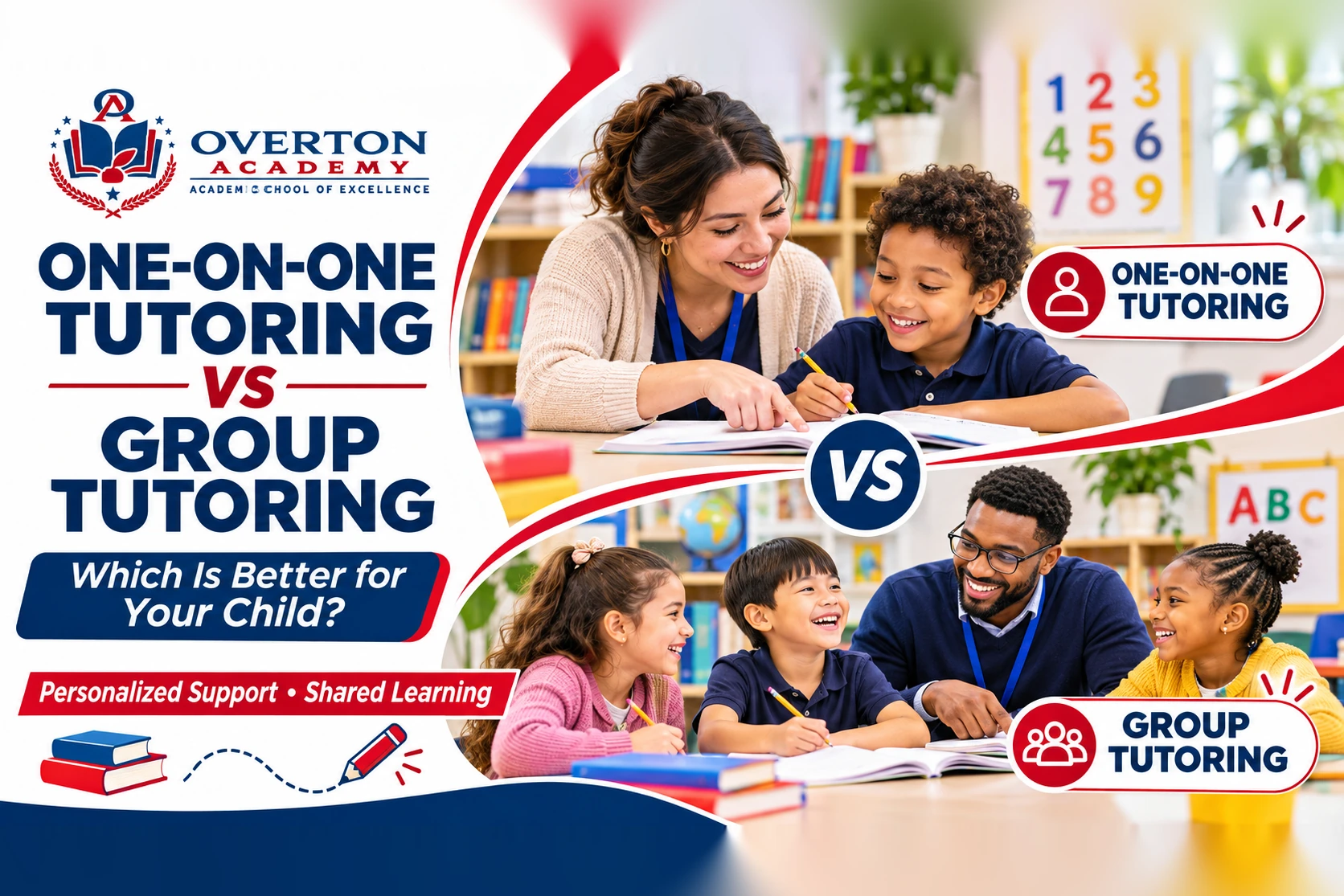
One-on-one tutoring pairs a child with a single tutor for focused, personalized instruction. Group tutoring places a few children with similar needs together with one tutor. Both formats target specific skill gaps, but one-on-one tailors everything to a single learner, while small groups add peer interaction and usually cost less per child.
The difference shows up in four places: attention, pace, interaction, and cost.
In one-on-one sessions (also called private or individual tutoring), every minute belongs to your child. The tutor changes the explanation, the examples, and the speed as your child responds.
In small-group sessions, the tutor shares attention among a few children who need help with the same skill, such as reading fluency or multiplication. The group sets the pace, and children often learn from each other’s questions.
How Small Is “Small” in Group Tutoring?
The Education Endowment Foundation (EEF), a UK charity that reviews classroom research, defines small group tuition as one adult teaching two to five pupils. Its rule of thumb is that “the smaller the group, the better.”
Once a group feels like a regular classroom, the personal attention that makes tutoring work starts to fade. Ask any provider how many children share a session before you sign up.
What Does the Research Say About One-on-One Tutoring vs Group Tutoring?
The EEF measures results in months of extra progress compared with similar pupils who did not receive the support. On average, one-to-one tuition adds about five months of progress, while small group tuition adds about four.
Those numbers make one-on-one look like the clear winner. The EEF cautions against that reading.
Studies that compare the two formats show mixed results. Sometimes one-on-one tutoring produced more progress. Other times, groups of two or three worked equally well or even better. The EEF suggests that the quality of teaching very small groups may matter more than the exact group size.
Three other findings help parents of elementary-age children:
- Tutoring works best when it ties directly to what your child studies in class.
- Studies in primary schools tend to show larger gains than studies in secondary schools.
- Experienced, trained tutors tend to get stronger results than untrained helpers.
One caveat: these figures are averages across many studies, and your child is not an average. Treat them as a guide, not a verdict.
When Does One-on-One Tutoring Work Better?
One-on-one tutoring works better when your child needs undivided attention to rebuild a skill or a sense of confidence.
One-on-One Tutoring Benefits: Where It Shines
- Custom pace. The tutor slows down or speeds up in real time, so your child never gets lost or bored.
- Privacy. Children can admit confusion without classmates watching. That matters for kids who hide what they don’t understand.
- Rapport. One steady relationship builds trust, and trust makes children more willing to try.
- Precision. The tutor spots the exact misunderstanding behind a wrong answer and fixes it at the source.
Where It Falls Short
- Cost. The EEF rates one-to-one tuition as moderate in cost, and it tends to run higher than group sessions.
- Flexibility. Sessions revolve around one family’s calendar, so they are easy to move and easy to skip.
- No peer learning. Your child never hears a classmate’s question or explains an idea to someone else.
One-on-one tutoring tends to fit children who are well behind, nervous about speaking up, still learning English, or stuck on a very specific problem.
When Is Group Tutoring the Better Choice?
Group tutoring is the better choice when your child is close to grade level, works well with others, and needs practice on a skill that classmates share.
Group Tutoring Benefits: Where Small Groups Shine
- Peer learning. Children hear different questions and explain ideas aloud. Explaining often deepens understanding.
- Lower cost. Several families share one tutor’s time, so each child’s share is usually smaller.
- Less stigma. Extra help feels normal when other children get it too.
- Built-in motivation. Friendly competition and shared progress keep many children engaged.
Where Small Groups Fall Short
- Shared pace. The tutor can’t stop for one child as long as a private session would.
- Matching risk. Children with mixed levels or different gaps can end up with lessons that fit nobody well.
- Quiet children. Some kids stay silent in a group and hide their confusion.
How Do the Two Formats Compare Side by Side?
| Factor | One-on-one tutoring | Small-group tutoring |
| Attention | Entirely on your child | Shared among a few children |
| Pace | Set by your child | Set by the group |
| Peer interaction | None | Built in |
| Cost per child | Usually higher | Usually lower |
| Comfort for shy children | Private, low pressure | Can feel like a spotlight |
| Best for | Deep or very specific gaps | Shared skills and steady practice |
How Do You Choose the Best Tutoring Option for Your Child? Try the Gap, Spotlight, and Goal Test
Three questions point you toward a format. Answer each one honestly, then look at the pattern.
1. How Big Is the Gap?
A deep, wide, or unclear gap points to one-on-one, because a tutor can find the root problem first. A narrow gap that classmates share, like multiplication facts, points to a group.
Not sure what the gap is? Start with the teacher. Parents of younger children can also scan the kindergarten readiness checklist, which lists foundation skills worth checking before gaps grow.
2. How Does Your Child Handle the Spotlight?
A child who freezes when called on points to one-on-one. A child who lights up around friends points to a group. Watch how your child acts at the dinner table or during a playdate.
3. What Are the Goal and Timeline?
Catching up before the next unit calls for focused, one-on-one attention. Building steady confidence and routine practice suits a group.
The decision rule: if two of the three answers point the same way, start there. If they split, choose the smallest group or the shortest commitment available, and review progress after a few weeks.
What Are the Steps to Pick the Right Tutoring Format?
- Name the skill. Ask your child’s teacher which exact skill is slipping, and write it in one sentence.
- Observe your child. Notice whether they ask for help or hide mistakes during homework.
- Set one goal and a review date. For example, “read a grade-level paragraph and explain it” by the end of the term.
- Ask providers three questions. How do you assess children first? How many share a session? How do you connect lessons to my child’s schoolwork?
- Review and adjust. Check in with the tutor and your child. If the format isn’t working, change it.
Still comparing programs overall? Our guide to choosing the right school for your child lists questions worth asking.
What Do Most Parents Get Wrong About Tutoring Formats?
Mistake 1: Assuming One-on-One Always Wins
Do this: choose by need. Not that: choose by price or prestige. The EEF found mixed results when it compared formats, so a well-run group can beat a poorly matched private session.
Mistake 2: Joining Any Group
Do this: ask how children are matched by skill. Not that: accept a group because it has an open seat. Groups work when children share a similar need.
Mistake 3: Treating Tutoring as Separate From School
Do this: share the teacher’s feedback with the tutor. Not that: let the two run on separate tracks. Tutoring is more likely to help when it links to regular lessons.
Mistake 4: Skipping Your Child’s Opinion
Do this: ask how your child feels about working alone or with others. Not that: decide for them. A comfortable child is more willing to take risks and ask questions.
What Does This Look Like for Real Families?
The two children below are an illustrative example, not real clients.
Picture Maya, a third grader who reads aloud smoothly but can’t explain what she read. She dislikes being corrected in front of friends. A tutor working one-on-one can slow down, ask gentle questions, and build her confidence before anyone else hears her answers.
Now picture Eli, a third grader close to grade level who needs steady practice with multiplication. He enjoys competing with friends, and several classmates share the same gap. A small group gives him practice, energy, and a lower cost for his family.
Needs also change. Maya might move into a small group once her confidence grows. Eli might need a few private sessions if a new topic trips him up. The best format today may not be the best format in three months.
How Does Overton Academy Handle One-on-One and Group Tutoring?
Overton Academy’s Tutoring Services include both personalized one-on-one and small-group instruction. This is personalized tutoring for kids built around each child’s learning style, abilities, and goals. Educators identify strengths and gaps first, then create an individualized learning plan.
Sessions cover reading, writing, math, language development, and homework support. The team also keeps open communication with parents, so learning continues beyond the classroom.
Families who want homework help in a group setting can look at the after-school program, which pairs homework help with creative play and social skill-building.
Inglish Cooke, a former school district professional and parent advocate for children in special education, founded Overton Academy with families’ needs in mind: personalized support and strong communication.
Ready to Find the Right Fit for Your Child?
You now know what to look for, and you may want an expert to look at your child’s needs with you. The team at Overton Academy can explain how one-on-one and small-group tutoring work for your child’s age and goals. Visit the Tutoring Services page to see how the sessions work and take your next step.
Final Thoughts
So who wins the one-on-one tutoring vs. group tutoring debate? Neither, on its own. The research shows both formats help, and it points to teaching quality as a big part of the story.
Start with a clear gap. Watch how your child handles the spotlight. Set a goal you can review, then adjust as your child grows.
Formats are tools. Your child’s confidence is the goal. When you’re ready to talk it through, the team at Overton Academy can help you match the format to your child.
Which skill would you most like your child to feel confident about by the end of this term?
Frequently Asked Questions
Is one-on-one tutoring better than group tutoring?
Not always. One-on-one tutoring gives more individual attention, and research shows slightly larger average gains, but small groups can work equally well when children are well matched, and the group stays small. The better choice depends on your child’s gap, comfort level, and goal.
How many students are in a small tutoring group?
Small tutoring groups usually include two to five children. The EEF uses that range, and it notes that smaller groups tend to work better. Ask any provider how many children share a session, because a large group can feel like a regular classroom.
Is group tutoring cheaper than one-on-one tutoring?
Yes, group tutoring usually costs less per child because families share one tutor’s time. Prices vary by provider, so ask for the exact fee structure before you decide. The lower cost makes groups a practical starting point for many families.
Is one-on-one tutoring worth the extra cost?
It can be, especially when your child has a deep or very specific gap, or feels nervous in groups. The EEF notes that one-on-one costs more, and that small groups can be a cost-effective option to try first. Set a goal, review progress after a few weeks, and adjust.
Which is better for a shy child?
One-on-one tutoring is often a gentler start for a shy child because no classmates are watching. Some quiet children warm up in a very small group once they feel safe, though. Watch how your child responds, and ask the tutor how they draw quieter children into sessions.
Can my child switch between group and one-on-one tutoring?
Many programs allow it, and children’s needs often change over time. Ask the provider before enrolling how placement works and how easily your child can move between formats. A good tutor will welcome a review after the first few weeks.
How do I know if my child needs tutoring?
Look for homework that takes far longer than it should, a teacher flagging a specific gap, or a drop in confidence. Talk with the teacher first, so you know which skill needs support. Tutoring works best when it targets a clear need.
How long does it take to see results from tutoring?
Timelines depend on your child and the size of the gap. Early changes, such as steadier homework routines and more willingness to answer questions, can appear before report-card grades shift. Ask the tutor for regular progress updates so you can see what is working.
What should I look for in a tutor or tutoring center?
Look for experienced, trained tutors who assess your child first, set clear goals, and connect lessons to classroom learning. Ask how they match children, how large the groups are, and how they share progress with parents. Clear answers signal a well-run program.
Does Overton Academy offer both one-on-one and small-group tutoring?
Yes. Overton Academy’s Tutoring Services include personalized one-on-one and small-group instruction in reading, writing, math, language development, and homework support. Educators build an individualized plan around your child’s strengths and goals, so the format follows what your child needs.