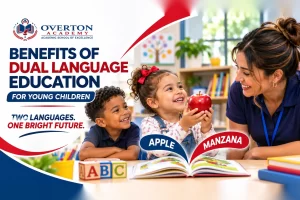
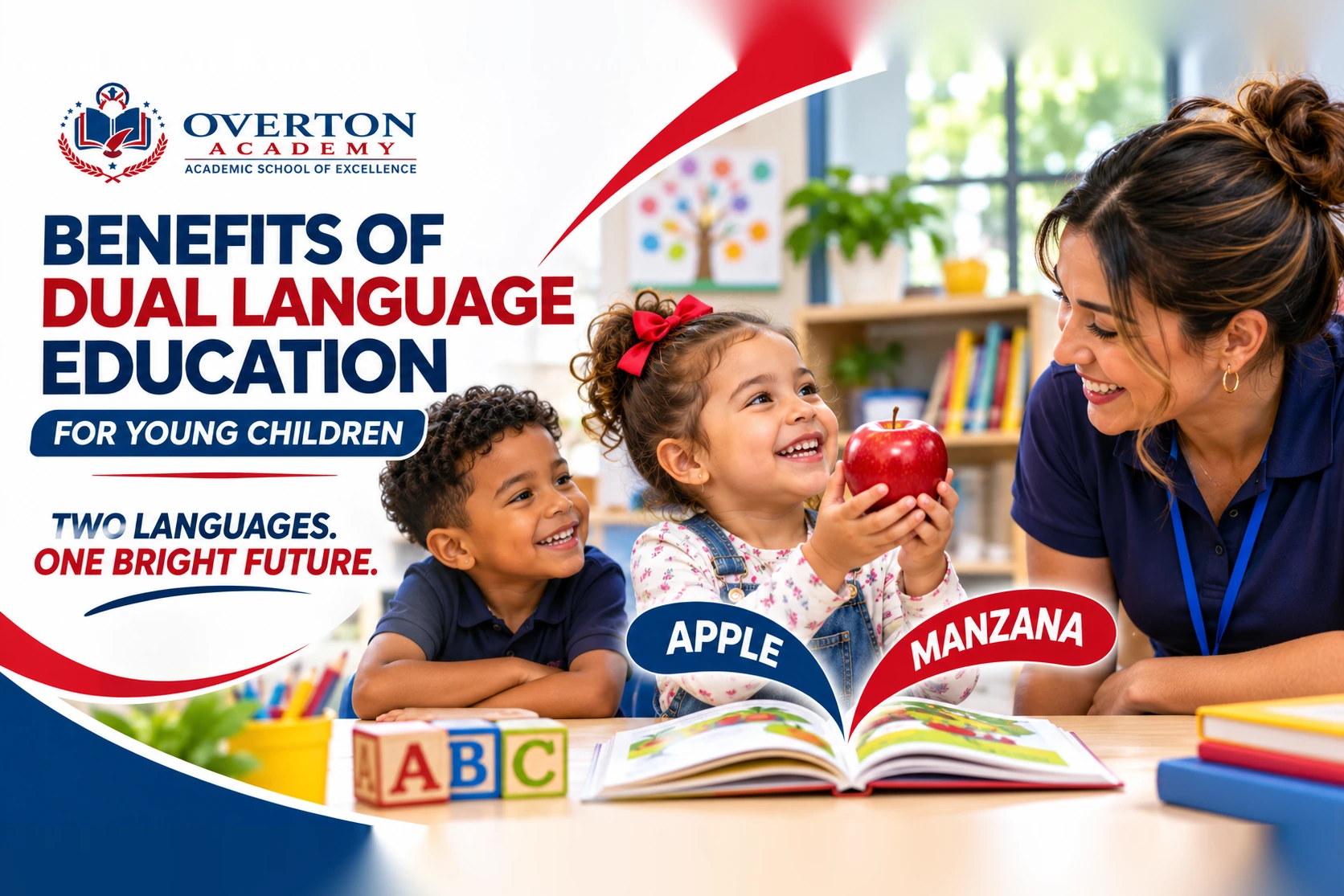
Your daughter holds up a red apple and calls it a manzana. Then she checks your face to see whether she got it right.
Moments like this send many parents straight into research mode. Will two languages crowd out English? Does a second language really help at this age, or is it just a nice extra?
The benefits of dual language education are better supported than most families expect. At Overton Academy in Uniondale, NY, parents ask about this all the time, so this guide covers what the research shows, where the evidence has limits, and how to spot a strong program.
Key Takeaways
- Children can build their home language and English together. A National Academies committee found no evidence that two languages confuse young children.
- Studies link dual language education to stronger English, reading, and math, and link bilingualism to skills like attention and mental flexibility.
- The strongest programs let children hear, use, and value both languages every day.
- Parents don’t need a perfect accent. Talking, reading, and singing in the language you know best all count.
What Does Dual Language Education Look Like in Early Childhood?
Dual language education means children learn through two languages, usually English and a partner language such as Spanish. Both languages carry real weight. Children don’t study the second language as a once-a-week subject. They use it to sing, listen to stories, count, play, and make friends.
Bilingual education is the wider umbrella. It covers any approach that uses two languages in learning, and dual language programs are one well-studied type. This table shows how the common terms differ.
| Program type | What it usually looks like |
| Dual language education | Children receive instruction and meaningful exposure in both their home language and English |
| Two-way immersion | Native English speakers and native speakers of the partner language learn together in one classroom |
| Foreign language class | A language is taught as a separate subject during a short, set block of time |
Preschool versions look different from elementary ones. Instead of formal lessons, young children pick up language through songs, picture books, games, and daily routines.
This topic matters to a lot of families. Almost 40% of children enrolled in Head Start in 2024–2025 were dual language learners, according to the Children’s Equity Project at Arizona State University.
What Are the Benefits of Dual Language Education for Young Children?
The main benefits of dual language education for young children include stronger skills in two languages, steady English growth, better early literacy, sharper attention and flexible thinking, closer family connections, and wider opportunities later in life. Research links these gains to high-quality programs that build the home language alongside English, not in place of it.
Here is how each benefit shows up for a young child.
Two languages grow side by side
Children in dual language settings develop real competence in both languages. Strong home language skills also help with English. The Children’s Equity Project’s review found that rich home-language experiences build vocabulary, background knowledge, and literacy skills that support learning as English develops.
Think of it as one foundation with two doors. A child who learns what a “caterpillar” is in Spanish already understands the idea when the English word arrives.
English grows too
Many parents worry that time spent in a home language slows English. The research reviewed by the Children’s Equity Project says otherwise. Children who receive dual language instruction can show stronger English acquisition than peers in English-only models, and one Head Start study found that preschool dual language learners with home-language support had higher language skills than children taught only in English.
Attention and flexible thinking
Researchers have linked bilingualism to working memory, selective attention, attention switching, and mental flexibility. These are the skills young children use to follow directions, wait their turn, and shift from one activity to the next.
Treat this finding as an association, not a promise. The National Academies report says children who learn another language early may show gains in certain cognitive skills, which is a careful way of saying results vary from child to child.
Stronger reading and early academic gains
The best evidence comes from a RAND study of Portland Public Schools. Seats in the district’s immersion programs were assigned by lottery, so researchers could compare similar children. Students assigned to dual-language immersion outperformed their peers in English reading by about seven months in fifth grade and nine months in eighth grade. The study found no clear gain or loss in math or science.
Those students started in kindergarten, so the study doesn’t measure preschool directly. It does show where early language investments can lead.
Benefits that don’t show up on a test
Sarah, a leader at Amigos, a two-way immersion school, sums it up in a video the school shared: “the benefits are cognitive, social, and economic.”
Another educator in the same video talks about empathy. Learning in a second language, she says, helps children step into someone else’s shoes and see the world the way they see it. That is a hard thing to measure, and an easy thing to notice at the dinner table.
Closer family ties
Language is how children talk with grandparents, cousins, and neighbors. The National Academies report warns that children who don’t keep their home language may lose the ability to communicate with relatives and may drift from their cultural heritage. Dual language learning protects that bridge.
Support for children with disabilities
Children with disabilities or language impairments can also become bilingual. The Children’s Equity Project’s review found no added delay or confusion, and it found that home-language interactions support communication and social development. Limited English is not the same thing as limited ability.
Opportunities that last into adulthood
The same review links bilingualism with better employment and earnings later in life. A second language becomes a skill children carry with them long after preschool.
Will Two Languages Get in Each Other’s Way?
No. A National Academies committee reviewed the evidence and found no sign that using two languages confuses young children or hinders either language. That holds when a child uses two languages at home, or one at home and another at school.
The same report recommends that teachers introduce English in a planned way during the toddler and preschool years while keeping the home language strong. The same report notes that preschoolers exposed to English often grow reluctant to keep speaking their first language, which is why steady home-language support matters.
You may hear your child mix words from both languages in one sentence. That is common and normal. It usually means your child is reaching for the best word they have, from everything they know.
What the Evidence Can and Can’t Tell You
Good research comes with limits, and a trustworthy guide names them.
The Portland study followed children from kindergarten through eighth grade in public school programs, not in private preschools. Cognitive findings describe links, not guarantees. Children also differ in temperament, family language, and how much they hear each language.
Program quality matters most. A dual language label on the door doesn’t tell you how much language children actually hear and use. That’s why the next section gives you a way to look past the label.
How Can You Tell a Strong Dual Language Preschool?
Use this three-part check on any tour. Remember it as Hear it, Use it, Value it.
The Hear It, Use It, Value It Check
Hear it
Children should hear both languages every day, in stories, songs, and teacher talk. Ask which adults speak which language and how the day is divided.
Use it
Children need to speak, not only listen. Look for games, projects, and play that invite children to answer, ask, and chat in both languages.
Value it
Both languages and cultures should feel like strengths. Strong programs involve families and look at what children know in both languages, not only English.
Questions to ask on a tour
- How much of the day happens in each language?
- How do teachers support children who are new to the partner language?
- Do lessons include songs, stories, and hands-on play?
- How do you share progress with families?
- What cultural traditions and celebrations does the classroom include?
Common Mistakes Parents Make (and What to Do Instead)
Most worries about raising a bilingual child come from myths. Here are the five that come up most.
| Not that | Do this |
| Wait until English is “solid” before adding another language | Build both together. Research supports introducing English steadily while keeping the home language strong |
| Panic when your child mixes languages | Treat mixing as normal and keep responding warmly |
| Judge progress only in English | Notice what your child understands and can show in both languages |
| Expect fluency in a few weeks | Track small wins, like a new word, a song, or a question in Spanish |
| Drop the home language to help your child “fit in” | Keep talking, reading, and singing in the language you know best |
How Can Parents Support Two Languages at Home?
You don’t need to become a language teacher. Rich, warm interaction in the language you feel most comfortable using is what counts.
- Talk through your day. Name what you see, cook, and do. Everyday chatter builds vocabulary and background knowledge.
- Read together daily. Shared reading in any language supports early literacy. Our guide to preschool readiness skills shows where reading fits among the other skills children build before kindergarten.
- Sing songs and tell stories. Rhymes and songs let children play with sounds and words without pressure.
- Use both languages naturally. Skip strict rules. Let each language appear where it fits in your family’s routine.
- Show that both languages matter. Ask your child to teach you a new word, and celebrate when they do.
Here is an illustrative example, not a real family. A parent who speaks Spanish at home reads a bedtime story in Spanish each night. At school, the child learns English songs and then teaches the chorus to her grandmother. By spring, she tells the same story in both languages. The parent never needed fluent English for any of it.
How Does Overton Academy Build English and Spanish Skills?
Overton Academy’s dual-language classes help children build English and Spanish through songs, storytelling, games, hands-on activities, and group projects. Teachers work language into daily lessons and routines so children build vocabulary, listening comprehension, pronunciation, and early literacy at their own pace.
That approach lines up with the “use it” part of the check above. Children practice language by playing with it, not by memorizing lists. The program also includes cultural celebrations and interactive projects that build respect for different traditions and perspectives.
One parent review on the Overton Academy homepage puts it simply: “He’s learning and having fun at the same time!”
Overton Academy serves children ages 2 to 12 from its Uniondale and West Hempstead, NY locations, and it welcomes families from across Nassau and Suffolk counties. If you’re still weighing preschool itself, the benefits of preschool education guide explains how early learning builds confidence and school readiness. You can also read about the academy’s preschool program to see how daily learning is structured.
Ready to See Dual-Language Learning in Action?
You now know what the research says and what to look for in a program. The next step is to see it for yourself. Visit Overton Academy’s dual-language classes page to learn how children build English and Spanish through songs, stories, and play, then contact the team to ask about class times and enrollment. The Overton Academy team would be glad to answer your questions and help you find the right fit for your child.
Final Thoughts
Dual language education isn’t a race to English, and it isn’t a trade-off. The research points to children who build two languages together and gain stronger reading, sharper attention, and closer family ties along the way.
The benefits of dual language education grow when a program gives children daily chances to hear, use, and value both languages. Hold every school to that standard, and ask to see it in action.
Your child doesn’t need to choose between a home language and English. With the right support, both can thrive. What would it mean for your family if your child could learn in both?
Frequently Asked Questions
Is a dual language preschool a good idea for toddlers and preschoolers?
Yes, a dual language preschool can be a strong fit for many young children. Research links high-quality dual language education with stronger skills in both languages, steady English growth, and early academic gains. Program quality matters most, so look for daily use of both languages and teachers who respect every child’s pace.
What is the best age to start learning two languages?
Early childhood is a natural time to start, and no deadline closes the door. Research reviewed by the National Academies shows that infants, toddlers, and preschoolers can learn two languages without harm. Older children can also learn a second language successfully, so the best starting point is whenever strong teaching and family support are available.
Will dual language education slow down my child’s English?
No, supporting your child’s home language does not slow English. The Children’s Equity Project’s review found that strong home language support can strengthen English development, especially literacy. Children in high-quality dual language programs can show stronger English growth than peers in English-only models, though results depend on how well the program is run.
Does learning two languages confuse young children?
No, research does not show that learning two languages confuses young children. A National Academies committee found no evidence that using two languages at home, or one at home and one at school, hinders either language. Mixing words from both languages is common and is not a sign of a problem.
Can my child benefit if we only speak English at home?
Yes, children who speak only English at home can gain from dual language programs. The Portland study that found reading gains reported similar effects for native English speakers and native speakers of other languages. Because every program differs, ask how much of the day uses each language and how teachers support children new to the partner language.
What is the difference between dual language and bilingual education?
Bilingual education is the broad term for any teaching that uses two languages, while dual language education is one type of it. In dual language programs, children receive instruction and meaningful exposure in both their home language and English. Many programs also bring native English speakers and native partner-language speakers together in the same classroom.
Can children with learning differences or disabilities learn two languages?
Yes, children with disabilities or language impairments can become bilingual without extra delay or confusion, according to research reviewed by the Children’s Equity Project. Home-language interactions also support their communication and social development. If you have concerns about your child’s learning, talk with the teaching team and your child’s specialists about the right language plan.
How does Overton Academy teach English and Spanish?
Overton Academy’s dual-language classes build English and Spanish skills through songs, storytelling, games, hands-on activities, and group projects. Teachers work language into daily lessons and routines, so children build vocabulary, listening, pronunciation, and early literacy without feeling overwhelmed. They also support each child at an individual pace and include cultural celebrations.
Where can I find dual-language classes near Uniondale, NY?
Overton Academy offers dual-language classes in Uniondale, NY, at 364 Uniondale Avenue, and serves families across Nassau and Suffolk counties. The academy also has a West Hempstead location. Call (516) 279-4252 or use the contact page to confirm which classes, schedules, and age groups are open at each center.
How much do dual-language classes cost, and how do I enroll?
Tuition depends on the program and schedule, so the best way to get an accurate figure is to ask Overton Academy directly. The team can explain current tuition, available assistance options, and the enrollment steps. Contact the academy by phone or through the contact page, and ask about class times for your child’s age.